Ages 6–16 · One hour · Hands on the tools
Teach a kid
to fix it.
Real household tools, real household repairs, taught one hour at a time. Fourteen classes take a kid from this is a Phillips to patching drywall, swapping a toilet flapper and hanging a TV on the studs.
ESA families welcome
Empowerment Scholarship Account · ask about reimbursement
- Class length
- 60 minutes
- Group size
- Up to 10 kids
- Parents
- Stay in the room
- Every kid
- Touches the tool
What the hour actually looks like
Same shape every time
Kids settle faster when the hour is predictable. Every class — drywall, toilets, doors — runs on the same five beats, so a kid who has been once already knows what happens next.
Tool Rules
Call-and-response, out loud, every single class. Nobody skips it and nobody is too old for it.
The tool, up close
What it is, what it is actually for, and the one way people get hurt with it.
Stations
Small groups rotate through hands-on stations. No demo-only hour — everybody drives a screw, patches a hole, turns a valve.
Stop and Ask
Scenario cards. “The drill is smoking.” “Water is coming up, not down.” Knowing when to go get an adult is a taught skill, not a personality trait.
Count them back
Every tool counted back into the box out loud before anyone leaves. It is how the shop stays safe and how kids learn that cleanup is part of the job.
The curriculum · 14 classes · 3 levels
From the toolbox to the whole house
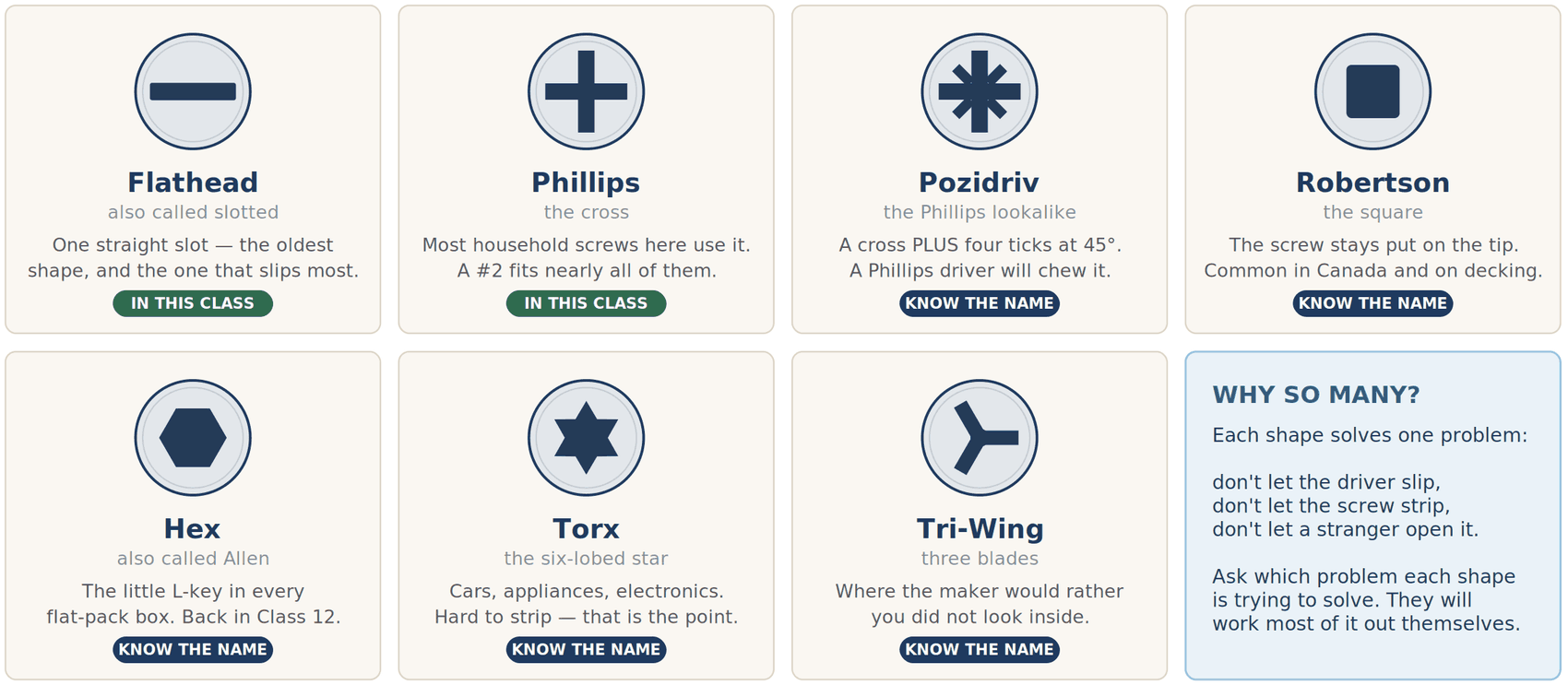
Classes work standalone — take one, take all fourteen. Taken in order they build: you cannot patch drywall until you can measure, and you cannot hang a TV until you understand anchors.
Level 1
Foundations
The four classes everything else stands on.
Level 2
Real Repairs
The five things that actually break in a house.
Level 3
Finish & Independence
Making it look right, then doing it without you.Look inside a class
Drawn on purpose
Every class is built around figures drawn from scratch for this course — not clip art and not a manufacturer's catalogue page. Kids get the printed sheet to take home, so the explanation does not leave when the hour does.
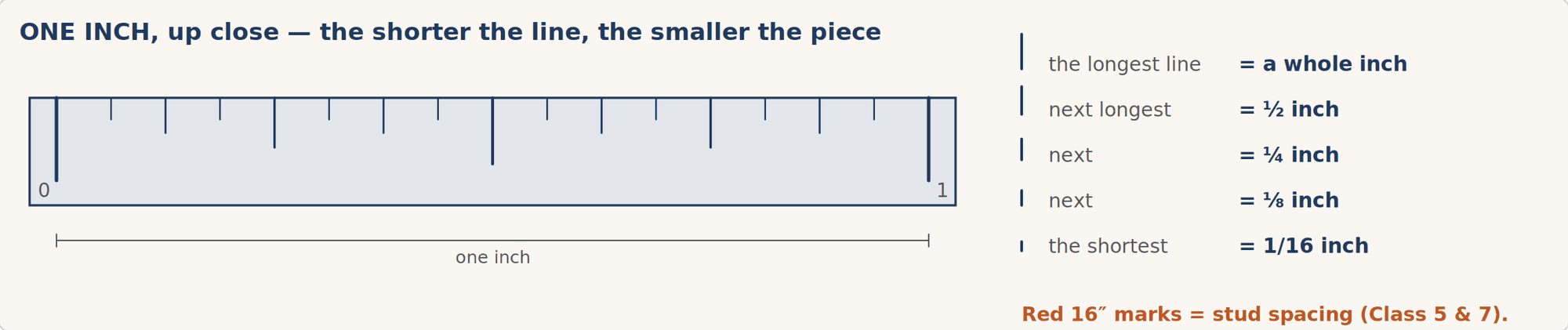
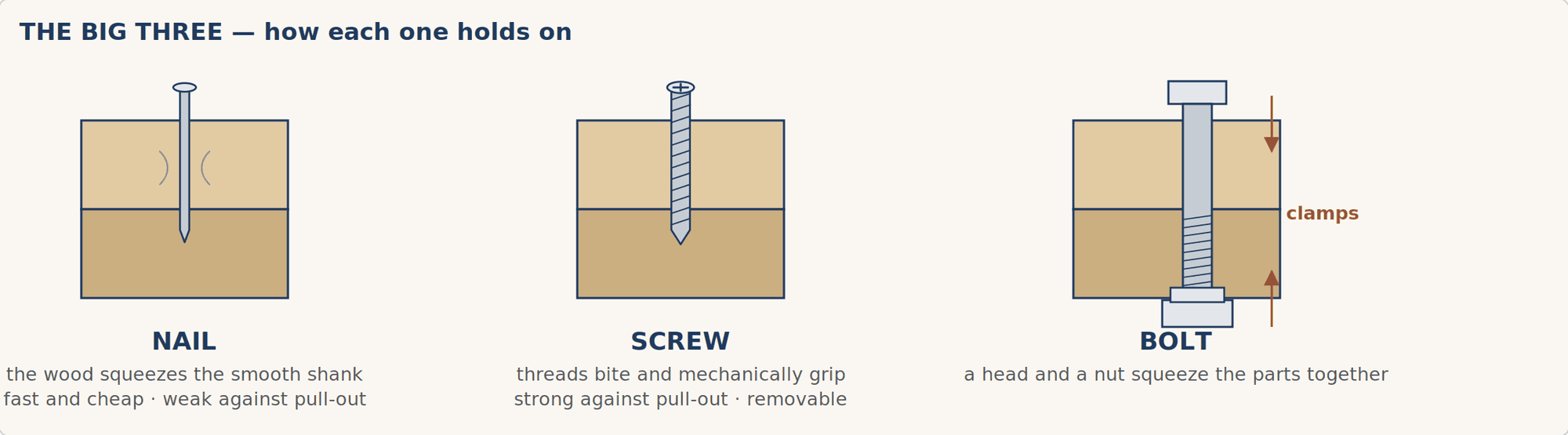
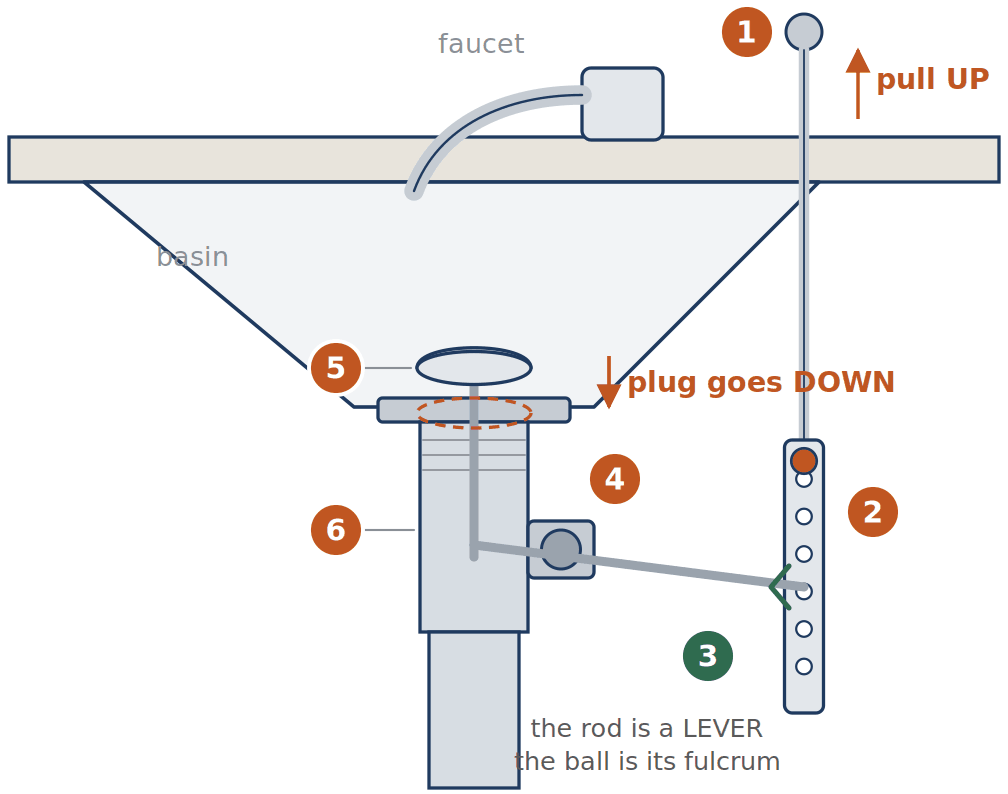
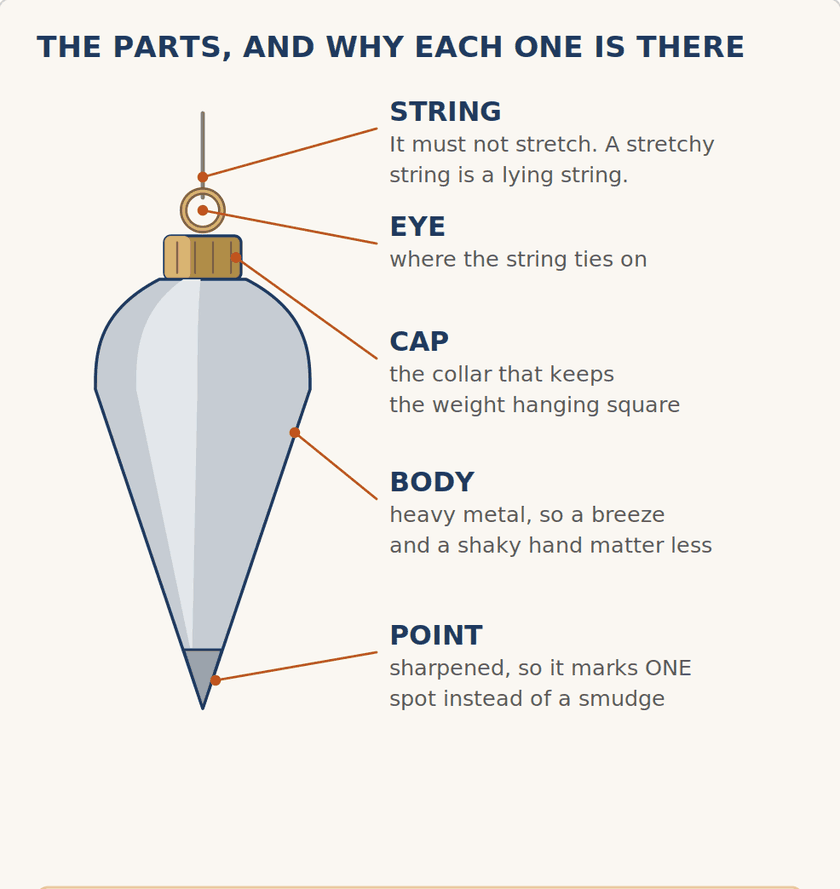
Why this matters for a parent: the curriculum is written down — a run of show to the minute, a materials list, and the specific things that go wrong. You are not booking an hour of someone winging it.
Build days · 90 minutes · Something to take home
Leave with a thing you made
Standalone build sessions, no prior class required. Kits come pre-cut — there are no power saws in any youth session — so the ninety minutes go into layout, fastening and finishing.
Planter Box
Cedar. Measure, square it up, fasten, plant it the same week.
Bird House
Angles, a roof that sheds water, and a hole sized for a specific bird.
Tool Tote
The box the rest of the course lives in. Handle, dividers, their name on it.
Step Stool
First build that has to hold a person. We talk about why that changes things.
Sawhorse
Splayed legs, gussets, real geometry. Built in pairs because it takes four hands.
Key & Mail Rack
Goes straight on the wall at home — which means it has to find a stud.
Bird Feeder
Build it, hang it, and learn where it has to go so birds don't hit the window.
New · Car Basics elective · Ages 10–16
The other thing
nobody teaches
A car is the first expensive, dangerous thing a teenager gets handed, and most of them are handed the keys without ever being shown how to look at it. These classes start at ten, not six — the rest of the course runs from six.
The Five-Point Walkaround
60 minutes · Ages 10–16 · On my car
Pilots walk all the way round an aircraft before every flight, in the same order, looking for anything different from last time. A driver can do the same in five minutes. Tires, lights, glass, fluids, dashboard — find the tire sticker, check tread with a penny, read the fluid levels, sort the warning lights by color.
The rule is check, don’t fix. Nobody adds air, oil or coolant. Nothing gets topped up, tightened or repaired. They look, read and report, and an adult decides what happens next. The hood is adult-opened and the only thing a student pulls out is the dipstick.
Take homeThe Walkaround Check Card, and their penny.
Swap Your Wiper Blades
60 minutes · Ages 10–16 · On your own car
The first time they fix something on a car instead of just checking it — and a deliberately small one. Engine off, hood shut, no fluids. Tell a worn blade from a good one, work out whether your car takes whole blades or refills, get the old one off and the new one on without letting the arm snap back onto the glass, then test it on wet glass.
One family per car with an adult at that car throughout, and I move between them. Everyone writes down their own sizes so the next swap takes ten minutes on the driveway.
You bringNew blades sized for your car, unopened and with the receipt · the owner’s manual · a bath towel. A week before, you get a sheet telling you how to find the right size.
Still being written: a flat-tire class and a dead-battery class. Pricing for the car elective is [ set the price ] — ask when you book and I’ll tell you what the next date is.
Three age bands · One curriculum
A six-year-old and a
sixteen-year-old, same hour
Every class is written in three bands. Same subject, different job, different tool in hand — so siblings can take the same class without one of them being bored or lost.
6–9
Helpers
Name it, hold it, hand it over correctly. Hand tools only. Success is vocabulary and grip.
10–13
Builders
Run the step start to finish with an adult watching. Earns the drill license.
14–16
Apprentices
Diagnose before they touch anything, then do the repair and explain why it worked.
Earned, not given
License · Ages 10+
Drill & Driver
Earned in Class 4 by demonstrating it, not by turning ten. Required before any drill touches a hand.
License · Ages 14+
Utility Knife
The highest bar in the course. In every class below it, the knife is instructor-only — no exceptions, no “just this once.”
For parents
How we keep this safe
The honest answer to “are you handing my kid a power tool?” is: eventually, once they have shown they can, with an adult at their shoulder. Here is everything else.
Parents stay
Not a drop-off
You stay in the room. Bring a coffee and a chair — most parents end up learning the drywall patch too.
Never
No power saws
No saw of any kind in any youth session. Every build-day kit arrives pre-cut.
Gated
Licenses before tools
Drill at 10+, utility knife at 14+, and both are earned by demonstration in class before they are used.
Every class
Stop and Ask cards
We rehearse the moment it goes wrong. Kids practice walking away and getting an adult — out loud, in front of everyone.
Every class
Eye protection
Provided and worn by everyone in the room, including the adults, including during cleanup.
Before you start
Waiver & media release
Signed once per family before the first class. You get it to read beforehand, in plain English, and it says exactly what the risks are.
Dates
Classes go out a few weeks ahead
Tell me your kids’ ages and I will send the next few dates that suit them. Online booking opens the moment the schedule is posted.
Pricing
What it costs
Materials are included in every class price — no kit fee at the door, nothing to buy beforehand. The one exception is the wiper-blade session, where you buy blades for your own car; everything else is on me.
| Format | Length | What you get | Price |
|---|---|---|---|
| Single class | 60 min | Any one of the fourteen. The easiest way to try it. | $35PER STUDENT |
| Six-week series | 6 × 60 min | One level, start to finish, same group of kids each week. | $210PER STUDENT |
| Build day | 90 min | Materials and the finished object to take home. | $75PER STUDENT |
| Homeschool day program | 3 hr | Weekday mornings, three classes back to back. | $105PER STUDENT |
| Private event | 2 hr | Birthdays, scout troops, co-ops. We come to you, up to 10 kids. | $650FLAT RATE |
Who is teaching
Built by an engineer
who is also a dad
- Instructor
- Soroosh Majidi
- Day job
- Aerospace systems engineer
- Field
- Crewed spacecraft & habitats
- Kids of his own
- Four
- Based in
- Phoenix, Arizona
I spend my working life on systems where a person's safety depends on a procedure being written clearly enough that someone can follow it under pressure. Then I come home to four kids who cannot hang a picture.
That gap is what this is. Not a craft class and not a woodworking club — a short, repeatable course in the tools and repairs that every adult is quietly expected to already know, taught with the same care I would put into a procedure somebody has to get right the first time.
Every class is written down: a run of show to the minute, a materials list, the specific things that go wrong and what to do about them. My own kids were the first students, and they are still the toughest audience I have.
Before you book
Questions parents ask
Do I have to stay?
Yes. Classes are parent-attended, not drop-off. You do not have to participate — plenty of parents sit at the back and answer email — but you stay in the room.
My kid has never touched a tool. Is that a problem?
That is the intended student. Class 1 starts at “this is a Phillips and this is a flathead.” Nobody is behind.
Do the classes have to be taken in order?
No. Every class stands alone. They do build on each other, so if you are taking several, going in order gets more out of them — but you can start anywhere.
Can my 7-year-old and my 14-year-old take the same class?
Yes, and it works well. Each class is written in three age bands, so they are working on the same subject at different levels in the same room.
We use an Arizona ESA. Does that work here?
Instruction and curriculum are both allowable ESA expenses, so classes like these are the kind of thing an account is meant to cover. Say so when you book and I will walk you through the receipt side and what your account needs from me.
What should they bring?
Closed-toe shoes and hair tied back. Everything else — tools, materials, eye protection — is here.
Will you come to us?
Yes, for private events, co-ops, scout troops and birthday parties. Two hours, up to ten kids, we bring the whole shop. You provide a table and a floor we can sweep.
What if we have to cancel?
Plans change — just tell me. Cancel any time up to 24 hours before and there is nothing to pay. Inside 24 hours I have usually already cut the materials for your child, so let me know as early as you can. There is no cancellation fee.
Book a seat
Pick a class
Reserve the seat now and pay at the class — nothing to pay today. Cancel any time up to 24 hours before.
Loading classes…
Next step
Come build something
Tell me your kids' ages and what you want them to be able to do, and I will tell you which class to start with. If you use an Arizona ESA, say so and I will walk you through it.
- Phone / text
- (480) 256-2381
- Where
- [ neighborhood or venue ], Phoenix AZ
- Booking
- [ booking link goes here ]
- ESA
- Using an Arizona ESA? Say so and I will sort the paperwork with you.